
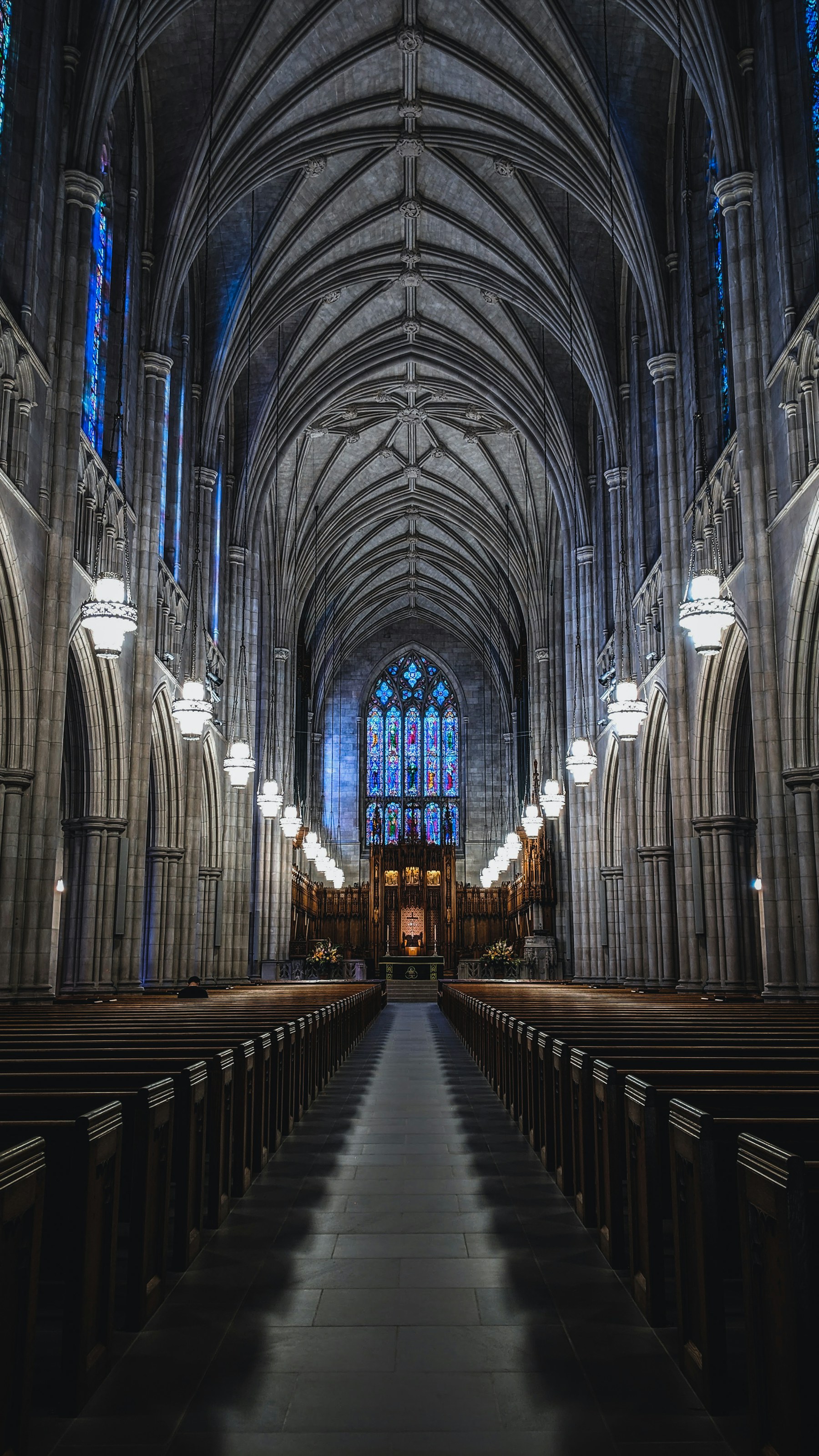
Sacred spaces can be among the most culturally significant and technically complex places encountered in historic preservation. The phrase can describe an active church, synagogue, mosque, temple, meetinghouse, cemetery, burial ground, ceremonial landscape, pilgrimage place, or a natural feature with religious or cultural meaning.
But sacred space isn't a formal National Register property type, and the label by itself doesn't establish historic significance, National Register eligibility, or legal protection. In preservation work, the important question is which specific framework applies to the place and why it matters to the people associated with it.
Sacred space isn't one preservation category
Several preservation concepts can overlap at a sacred place without meaning the same thing. A church or synagogue may be evaluated as a religious property under the National Register criteria. A cemetery has its own National Register considerations. A place whose importance comes from an ongoing cultural relationship with a living community may qualify as a traditional cultural place. A Tribal sacred site on federal land can also raise separate federal responsibilities under Executive Order 13007.
Those categories shouldn't be collapsed into one another. Preserve Signal's guide to traditional cultural properties and traditional cultural places explains why a sacred site isn't automatically a traditional cultural place, and why a traditional cultural place isn't necessarily sacred.
Religious properties and the National Register
Religious properties receive special treatment under the National Register Criteria for Evaluation. Criteria Consideration A says a religious property is ordinarily eligible only when its primary significance comes from architectural or artistic distinction or from historical importance.
That doesn't mean historic churches, synagogues, mosques, temples, or other religious properties are excluded from the National Register. It means the significance has to be evaluated in secular historical terms rather than by judging the validity or importance of a faith or doctrine. A religious property may qualify because of architecture, art, community history, civil rights, education, social history, settlement, or another well-supported historic context.
The same basic framework still requires significance, historic context, and integrity. Preserve Signal's National Register criteria guide explains how Criteria A through D, integrity, and the Criteria Considerations fit together.
Active houses of worship and local preservation review
Local landmarking and zoning decisions involving active religious institutions can raise a different federal issue: the Religious Land Use and Institutionalized Persons Act, or RLUIPA. The U.S. Department of Justice identifies zoning and landmarking laws as land-use regulations covered by RLUIPA. Where the statute applies, a government can't impose a land-use regulation that creates a substantial burden on religious exercise unless the government can satisfy the statute's compelling-interest and least-restrictive-means test. RLUIPA also includes equal-terms and nondiscrimination protections.
RLUIPA doesn't make historic designation or preservation review unlawful by itself, and whether a particular restriction creates a substantial burden is fact-specific. It's also separate from Section 106: RLUIPA concerns land-use regulation affecting religious exercise, while Section 106 is the federal historic-preservation review process for undertakings with federal involvement. On an active religious property, both frameworks can appear in the broader project record for different reasons.
Sacred sites and traditional cultural places aren't synonyms
The distinction is especially important when Indigenous sacred places are involved. Executive Order 13007 uses a specific definition of an Indian sacred site for federal land management: a discrete location on federal land identified by a Tribe, or an appropriately authoritative Indian religious representative, as sacred because of established religious significance or ceremonial use.
That Executive Order definition isn't a substitute for the National Register. The Advisory Council on Historic Preservation notes that a sacred site has to be listed in or eligible for the National Register to be treated as a historic property in the Section 106 process. Executive Order 13007 is a separate federal-land-management authority: for Indian sacred sites on federal land, land-managing agencies are directed, to the extent practicable, permitted by law, and not clearly inconsistent with essential agency functions, to accommodate access and ceremonial use and to avoid adversely affecting physical integrity. Those duties don't depend on the site first qualifying for the National Register. A sacred place can therefore matter under Executive Order 13007 even when it isn't a Section 106 historic property.
How sacred spaces fit into Section 106
When a federal undertaking may affect a sacred place that is listed in or eligible for the National Register, Section 106 can become part of the project record. Formal National Register listing isn't required if the property is otherwise determined eligible.
Federal agencies also have specific consultation responsibilities toward Indian Tribes and Native Hawaiian organizations that attach religious and cultural significance to historic properties that may be affected. Section 106 doesn't give any consulting party an automatic veto and doesn't guarantee a preservation outcome. It requires the agency to identify historic properties, consider effects, and consult through the federal review process.
Sensitive information may not appear in public files. Preservation practitioners commonly refer to Section 304 of the National Historic Preservation Act, now codified at 54 U.S.C. § 307103. It allows certain information about the location, character, or ownership of a historic property to be withheld when disclosure could significantly invade privacy, risk harm to the property, or impede use of a traditional religious site. For project research, an incomplete public record shouldn't be treated as proof that no culturally sensitive resource exists.
Why preserving sacred spaces can require a different kind of research
Sacred places often carry values that aren't fully visible in the building fabric. Physical features still matter, but so can continuing use, community memory, ceremonial practice, burial traditions, landscape relationships, access, and culturally sensitive knowledge. That can make oral history, community consultation, archival research, landscape analysis, and careful documentation especially important.
A conventional historic resource survey may identify a building or site, but additional work can be needed to understand why the place is significant and which features or relationships carry that significance. For a building-focused project, a historic building conditions assessment may address physical needs without answering the separate historical or cultural significance questions.
What sacred-space records can signal about a project
For firms tracking preservation work, sacred-space records can reveal several kinds of developing projects. A congregation may commission a conditions assessment, roof or masonry study, stained-glass survey, accessibility plan, master plan, or rehabilitation design. A cemetery may need conservation planning or documentation. A federal project may trigger identification and consultation. A religious property may appear in a National Register nomination, grant file, capital campaign, or adaptive reuse study.
None of those records proves that construction is funded or imminent. The strongest signal comes from connecting the preservation activity with funding, design decisions, property control, approvals, procurement, or an executed agreement. The fact that a sacred place is being studied tells you something is moving; the surrounding record tells you what.
The practical takeaway
Sacred spaces matter in historic preservation, but the term is broader than any one federal category. A historic religious building, cemetery, traditional cultural place, and Tribal sacred site can overlap in real projects while remaining legally and procedurally distinct.
The useful approach is to identify the place, the community relationship, the applicable preservation framework, and the project action that brought it into the record. That makes the difference between simply seeing a religious or culturally important place and understanding its historic significance, review status, and potential role in an active preservation project.