
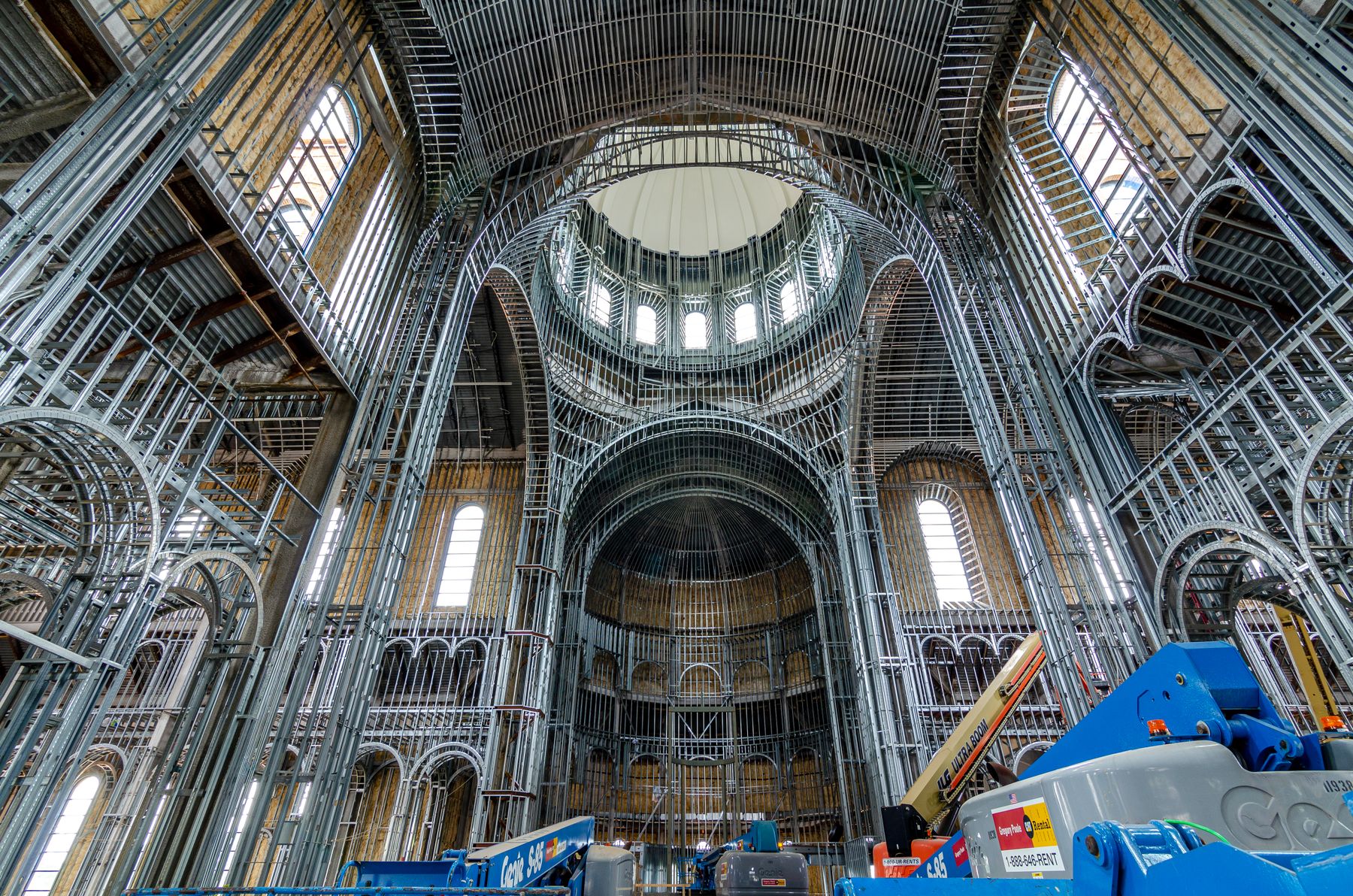
Historic preservation construction is the point where a preservation plan stops being an idea and becomes physical work. Drawings, specifications, investigations, approvals, budgets, and preservation standards have to be translated into a contract that a historic preservation contractor and specialty trades can price and execute.
That transition is unusually important on historic buildings because existing conditions are rarely as uniform or fully visible as they are in new construction. The contract documents may need to control selective demolition, protection of historic fabric, repair methods, material compatibility, testing, mockups, salvage, substitutions, and how unexpected discoveries are handled.
1. Design has to become an executable construction scope
A preservation design set has to do more than show the intended appearance. It needs to tell bidders what exists, what is known, what remains uncertain, what must stay, and how the proposed work will be judged.
National Park Service construction-document guidance is a useful illustration of that transition. Its design-bid-build process calls for coordinated construction drawings, Division 1 requirements, technical specifications, submittal lists, testing and inspection requirements, cost estimates, schedules, permit information, and supplemental reports. Not every project needs that exact federal package, but the underlying principle applies broadly: the more preservation-sensitive the work, the less safely it can be reduced to a few general notes.
- Existing-condition drawings and clearly defined limits of removal, repair, salvage, and protection.
- Material-specific specifications for masonry, windows, plaster, roofing, woodwork, metals, finishes, or other historic assemblies.
- Submittal requirements for samples, shop drawings, product data, qualifications, test results, and treatment procedures.
- Mockups or test areas where appearance, workmanship, compatibility, or cleaning methods need to be approved before full production.
- Unit prices, allowances, alternates, or other pricing devices when quantities or concealed conditions cannot be known precisely before work begins.
- Temporary protection, access, sequencing, hazardous-material controls, and site logistics appropriate to fragile or occupied historic buildings.
A historic building conditions assessment can help reduce uncertainty before the construction documents are finished. For material-specific work, Preserve Signal's historic masonry restoration guide shows how testing, samples, mockups, tool limits, and installer qualifications can become part of the eventual construction requirements.
2. Contractor selection depends on the owner and delivery method
There isn't one universal procurement method for historic preservation construction. Public and private owners can operate under very different rules, and even public owners may have different authority depending on state law, funding source, project value, and delivery method.
In a traditional design-bid-build project, the design team completes the bid package before construction is advertised. Some public procurements use sealed bidding, where award is generally made to a responsible bidder whose responsive bid is most advantageous under the stated price and price-related factors. Other procurements use negotiated or best-value procedures that can weigh technical approach, past performance, key personnel, and price. Private owners usually have more contractual flexibility, subject to financing, grant, tax-credit, or other project requirements.
That distinction matters because preservation work often rewards relevant experience, but an owner can't simply ignore the procurement rules that govern the project. A qualifications requirement has to be written and evaluated in a way the applicable solicitation and law permit.
3. What contractor qualifications actually matter?
A historic preservation contractor doesn't need to self-perform every preservation trade, but the team needs the ability to manage historic materials without treating them like ordinary demolition and replacement work. The most useful qualifications are tied to the actual scope rather than a generic claim that a company has worked on old buildings.
- Comparable completed projects involving the same materials, treatment methods, scale, access conditions, and level of significance.
- A superintendent or project manager with relevant preservation experience, not just company-wide experience that will not be present in the field.
- Named specialty subcontractors or craft firms for masonry, windows, plaster, decorative finishes, metals, roofing, millwork, conservation, or other critical work.
- A workable quality-control plan for samples, mockups, first-work reviews, documentation, protection, and correction of rejected work.
- Ability to meet bonding, insurance, schedule, safety, and financial requirements when those apply.
Rigid experience thresholds aren't automatically better. A requirement such as a fixed number of years in business may exclude capable firms without measuring whether the proposed crew has done comparable work. Well-written qualifications focus on demonstrable relevance to the work and remain consistent with the owner's procurement rules.
Preservation specifications also have to distinguish a true performance requirement from a brand preference. For federal acquisitions, FAR 11.104 permits a 'brand name or equal' description when the solicitation states the salient characteristics an equal product must meet, while FAR 11.105 generally prohibits requirements peculiar to one manufacturer unless the brand, product, or feature is essential and the required justification and approval are made. State and local public-bidding rules differ. On public preservation work, named repair mortars, coatings, terra cotta systems, or other specialized products therefore need to be coordinated with the applicable procurement rules rather than specified casually as sole-source products.
4. Specialty trades, testing, and mockups are part of the construction strategy
Many preservation scopes are won or lost at the specialty-trade level. A historic preservation contractor may coordinate repointing, window repair, ornamental plaster, sheet metal, slate or clay tile roofing, decorative finishes, stone repair, terra cotta, and conservation treatments that require craft knowledge not interchangeable with general construction experience.
Mockups are one of the clearest ways to turn a written preservation standard into an observable quality benchmark. GSA preservation specifications, for example, use test patches and mockup panels to evaluate methods before broad masonry work proceeds, and accepted mockups can serve as the quality standard for similar work.
Mockups and test areas can occur at different points in the project. During design, preservation architects or architectural conservators may perform or supervise small-scale investigative work within their contracted scope, such as paint stratigraphy, mortar sampling, cleaning trials, or other materials testing. Larger workmanship mockups and production test panels are usually executed by contractors or specialty trades. If hands-on trade work is needed before the main construction contract, it may be included in an enabling-work package, exploratory selective-demolition package, preconstruction scope, conservator scope, or other separately authorized work, subject to the owner's procurement authority. After award, mockups commonly become an early construction deliverable before production work.
5. Unknown conditions have to be allocated, not wished away
Historic buildings contain concealed conditions: embedded steel corrosion, voids, hidden framing changes, abandoned utilities, earlier repairs, undocumented openings, deteriorated substrates, and hazardous materials are common examples. Good documents investigate enough to define the work, but no practical preconstruction survey reveals everything.
The contract therefore needs a clear mechanism for uncertainty. Depending on the project, that may include unit prices, allowances, owner contingencies, selective demolition before final pricing, preconstruction investigation, or contract provisions addressing differing or concealed conditions. Those choices allocate risk differently, so they should be coordinated with the owner, designer, construction manager, and legal or procurement advisers rather than treated as boilerplate.
Hazardous-material investigation also needs to be sequenced before destructive work that could disturb suspect asbestos, lead-containing coatings, PCB-containing materials, or other regulated hazards. The remediation scope should also be coordinated with the preservation scope: environmental compliance doesn't automatically justify unnecessary loss of significant historic fabric. Depending on the material, condition, exposure risk, substrate, and governing requirements, stabilization, encapsulation, enclosure, selective removal, or other compliant approaches may be evaluated so that health protection and preservation are addressed together. Federal lead guidance for historic properties, for example, recognizes that wholesale removal of significant painted features can damage historic integrity and discusses preservation-sensitive controls where appropriate.
6. Early contractor involvement can help, but it is not one universal answer
Some owners bring construction expertise into the project before the drawings are complete. Construction manager at risk, construction manager/general contractor, design-build, progressive design-build, or a separate preconstruction-services agreement can provide early estimating, constructability review, logistics planning, trade input, and exploratory work.
That can be especially useful when access is difficult, the building is occupied, phasing is complex, or the design depends on uncertain existing conditions. It doesn't mean traditional design-bid-build is inherently unsuitable for preservation. A well-investigated, well-documented design-bid-build project can work successfully, while an early-collaboration delivery method can still fail if scope, roles, pricing, and preservation requirements are poorly defined.
7. Award is the start of another preservation review cycle
Contract award doesn't eliminate design decisions. Construction commonly brings shop drawings, samples, product data, RFIs, field discoveries, mockups, substitution requests, and proposed repair details that have to be reviewed against the contract documents and the preservation objective.
The contractor remains responsible for performing the work under the contract, while the architect, engineer, conservator, owner, or preservation reviewer performs the review role assigned by the agreement and applicable program. On Federal Historic Preservation Tax Incentives projects, an approved Part 2 doesn't give the field team blanket discretion to change approved treatments. NPS expects the completed work documented in Part 3 to be consistent with the approved rehabilitation, and changes in scope or treatment may need to be submitted as amendments or otherwise coordinated through the SHPO/NPS review process before consequential work proceeds. Work that is inconsistent with the approved project can require remedial work, jeopardize certification, or, in certain circumstances, support revocation after certification under 36 CFR 67.6(e)-(f).
That preservation-review obligation can be stricter than ordinary construction-administration authority. AIA A201 Section 7.4, for example, permits the architect to order minor changes that don't affect Contract Sum or Contract Time, but that contractual mechanism doesn't supersede tax-credit, grant, easement, local preservation, or other regulatory approvals. A substitution or field change that seems contractually minor can still be preservation-significant if it changes historic material, repair method, profile, finish, or the extent of replacement. Calling a change 'in-kind' doesn't automatically make it immaterial to preservation review.
The most effective teams establish that approval path before work begins. A preconstruction conference, preservation treatment plan, submittal schedule, mockup sequence, photographic documentation protocol, and clear stop-work or notification points can prevent a field decision from becoming irreversible damage.
What construction procurement can signal about a project
For firms tracking the preservation market, the construction phase produces some of the strongest project signals because the owner is moving from design intent toward a contract.
- Final or near-final construction documents, bid-ready specifications, or an updated Class A or engineer's estimate.
- Contractor prequalification notices, requests for construction management services, or invitations to bid.
- Pre-bid meetings, site walks, plan-holder activity, addenda, bidder questions, and issued clarifications.
- Bid tabs, evaluation memoranda, award recommendations, board approvals, or notices of intent to award.
- Executed construction contracts, bonds, permits, notice to proceed, mobilization, and early mockup or submittal activity.
Those signals are not interchangeable. A pre-bid conference means the procurement is active, but it doesn't identify the eventual contractor. A bid tab can reveal apparent pricing without proving award. An executed contract or notice to proceed is much stronger evidence that the work is moving into construction.
For the earlier stages, see Preserve Signal's guide to finding historic preservation projects before formal procurement. For the full lifecycle, see how to track a preservation project from funding through construction.
Quick answers
Is historic preservation construction a separate construction code or license category?
Not generally. It is a practical market term for construction on historic properties. Applicable licenses, codes, procurement rules, preservation reviews, and professional requirements depend on the jurisdiction and project.
Does the lowest bidder always win a public preservation project?
No. Some sealed-bid systems emphasize price among responsive bids from responsible bidders, while other lawful procurement methods use technical or best-value evaluations. The governing solicitation and law control.
Should a preservation contractor be selected before design is complete?
Sometimes. Early constructor involvement can help with pricing, investigation, phasing, and constructability, but it depends on the owner's delivery method and procurement authority.
Are mockups optional?
They are project-specific, but they are common and valuable when workmanship, color, texture, cleaning, repair methods, or material compatibility cannot be judged adequately from product data alone.
Why do preservation specifications matter so much?
Because they translate preservation intent into enforceable requirements for materials, workmanship, protection, testing, samples, mockups, sequencing, qualifications, and acceptance.
The practical takeaway
Historic preservation construction works best when the project does not treat procurement as a handoff from preservation thinking to ordinary construction. Investigation has to inform the drawings. The drawings and specifications have to define what is significant and how it will be treated. The procurement method has to fit the owner's legal authority and project risk. Contractor qualifications have to match the actual scope. And the field process has to protect historic materials while still giving the team a workable way to respond to unknown conditions.
For contractors and specialty firms, the most useful moment is often before the final award. Construction documents, prequalification, pre-bid activity, mockups, addenda, and award records reveal not just that a project is moving, but what skills, trades, sequencing, and preservation controls the owner is likely to require.